
Criminal Court Cases in East Carroll
The Sixth Judicial District Court is one of Louisiana's 43 judicial districts and serves East Carroll, Madison, and Tensas parishes. Its two elected divisions have original jurisdiction over criminal matters, including felonies and district-level misdemeanors. Louisiana does not sort felonies into one universal class system; an offense is a felony when hard-labor imprisonment may be imposed. That makes the filed statute and charging document more useful than a broad class label.
The East Carroll Clerk of Court keeps the criminal case file at the parish courthouse. A Lake Providence traffic or ordinance matter may follow a separate local path, but no official stand-alone municipal search was verified. Call the clerk or issuing agency to identify the right custodian rather than assuming every citation sits in the Sixth JDC index.
Two Sixth JDC Criminal Divisions
East Carroll cases may be assigned to Division A or Division B. The division, docket number, and parish identify the precise court file, so record requests should include all three when known. The district lists Division A Judge Angela L. Claxton at (318) 574-2712 and Division B Judge Laurie R. Brister at (318) 766-3233, while records and copies remain the clerk's function.
The Sixth JDC local-rule appendices provide court-office context, but current calendars and contacts should be checked with the live court or clerk before travel. Interpreter and language services are available through the district; arrange them before a Lake Providence hearing.
East Carroll Parish Case Record Searches
The clerk links to eClerks LA, a remote-access platform whose East Carroll criminal coverage, subscription, document access, and prices must be confirmed. A name is useful, but a docket number is the strongest locator. Add an approximate filing or arrest date and date of birth only when the clerk lawfully needs it to distinguish people with similar names.
- Gather the full name, case number, approximate filing range, and charge before searching.
- Try eClerks LA and confirm that its criminal index covers East Carroll and the needed years.
- Call the clerk at (318) 559-2399 if the case is absent or remote coverage is unclear.
- Ask first for the docket sheet and minute entries, then select the charging paper, judgment, or sentence needed.
- Request a certified disposition when the record must show the court's authoritative final result.
| Field Label | Type | Required | Notes |
|---|---|---|---|
| Username / password | Text | For gated functions | eClerks LA account access; confirm subscription terms. |
| Full legal name | Text or staff search | For name search | Add a date range to reduce false matches. |
| Case number | Text | No | Best exact locator when known. |
| Date of birth | Date supplied to staff | No | Use only for lawful identity matching. |
| Filing year / charge | Filter or staff detail | No | Helps locate spelling variants and older entries. |
Searching East Carroll Through eClerks LA
The eClerks LA portal is the main documented remote route, but it should be treated as one access layer rather than a complete archive. Registration may be required, parish participation can differ, and images of older pleadings may not be digitized. Confirm access price before subscribing and ask whether the desired criminal index and document years are available.
The portal's official landing view illustrates the account gateway used for remote clerk functions.
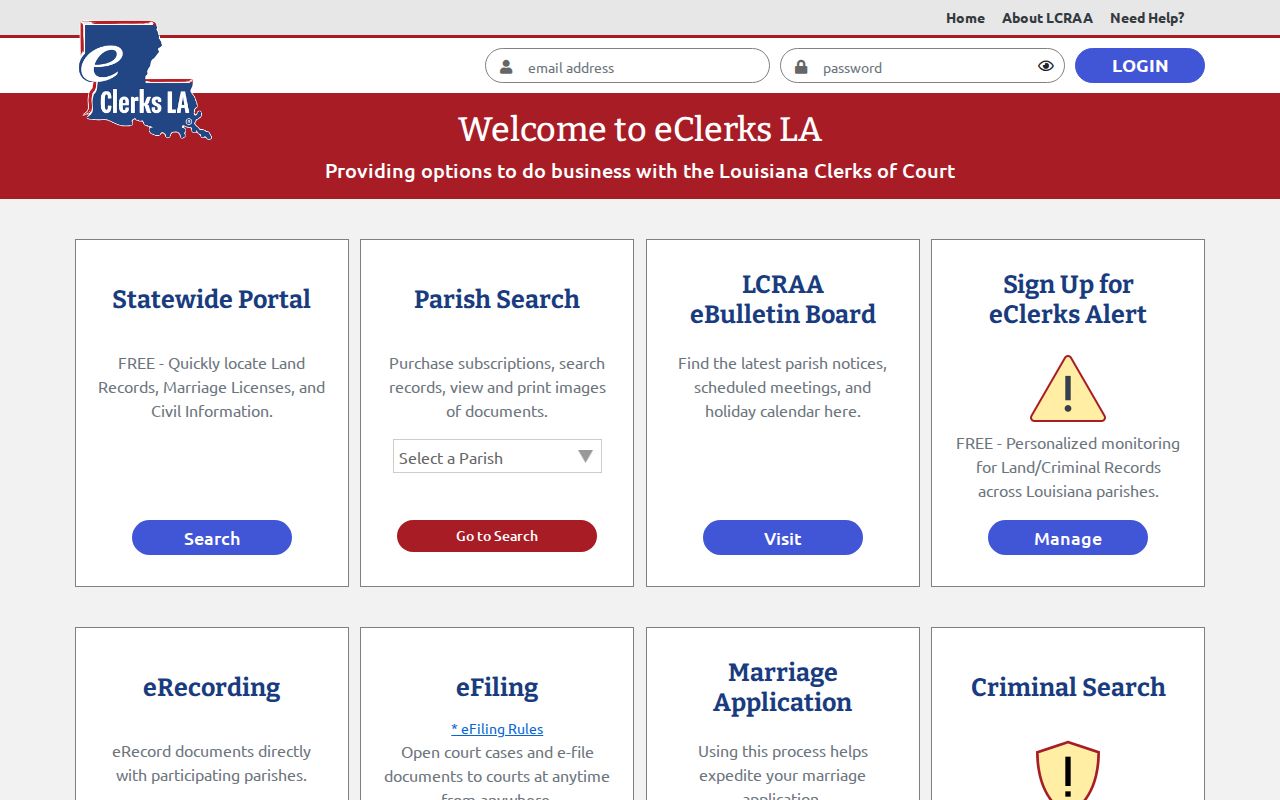
A blank online result is not proof that no East Carroll criminal case exists; counter and archive retrieval remain necessary fallbacks.
What a Criminal Case File Contains
A Sixth JDC case file describes one prosecution, not a person's full Louisiana criminal history. The docket traces filings and court events. The bill of information or indictment states the charge the prosecutor filed, which may differ from the allegation recorded at booking. Minute entries provide short official accounts of what occurred on hearing dates.
| Case Number & Court | Sixth JDC, East Carroll Parish, division, docket number, filing date, and status. |
|---|---|
| Charging Document | The complaint, bill of information, or indictment and each filed statute or count. |
| Docket Entries | Filings, motions, continuances, pleas, warrants, hearings, and other dated activity. |
| Hearing Dates | Scheduled and completed court events, often summarized in minute entries. |
| Disposition & Judgment | Dismissal, plea, verdict, or other outcome and the court's formal judgment. |
| Sentence & Conditions | Custody, suspended time, probation, fines, costs, restitution, and later revocation events when public. |
Reading a Sixth JDC Minute Entry
A minute entry is the clerk's concise record of what took place in court on a given date. “Arraignment” means the accused answered the formal charge. A “continuance” means the event was reset, not dismissed. A “capias” is court process often issued after a failure to appear or comply. A motion label shows that relief was requested; the ruling must be read separately.
Follow the record through the judgment and sentence. A plea entry may resolve a count, while a later sentencing minute supplies the actual terms. “Dismissed” or “refused” means prosecution did not continue on that charge at that stage, but it does not erase the arrest or booking record.
Bond, counsel, fines, costs, restitution, probation, and revocation may appear in public minutes when they are part of the proceeding. Read each entry in date order and note the division. A bench warrant can be issued and later recalled, so an old capias entry alone does not establish current warrant status. Confirm the latest order with the issuing court. Likewise, a scheduled trial date may be moved by a later continuance; the newest minute controls the current calendar.
Criminal Case Stages in East Carroll
After law enforcement makes an arrest, the prosecutor decides whether and what to file. The filed charge begins the court record and can replace or narrow the booking allegation. Arraignment records a plea. Pretrial motions and hearings resolve legal issues, and the case then ends through dismissal, plea, or trial. A conviction is followed by judgment and sentencing; probation or revocation events may add later entries.
Case flow: Charges Filed › Arraignment › Pretrial › Plea or Trial › Disposition › Sentencing
East Carroll Clerk Search and Copy Fees
Louisiana R.S. 13:847 sets district-clerk criminal record charges. A name-based criminal-history search is $20. Ordinary copies are $1 per page, a conformed copy is $3, certification is $5, and an extract of court minutes is $10. Ask the clerk to quote the full cost before copying, especially when a request spans many docket documents.
The clerk's criminal desk is at 400 First Street, Suite 3, Lake Providence, LA 71254. A focused request should state the docket number, division, defendant name, filing range, and exact items sought. Asking first for a docket sheet can keep a request narrow: after reviewing it, select the bill of information, key minutes, judgment, and sentencing document. For an older file, ask whether archive retrieval adds time and whether electronic delivery is available.
The official fee statute shows the source for these East Carroll court record charges.
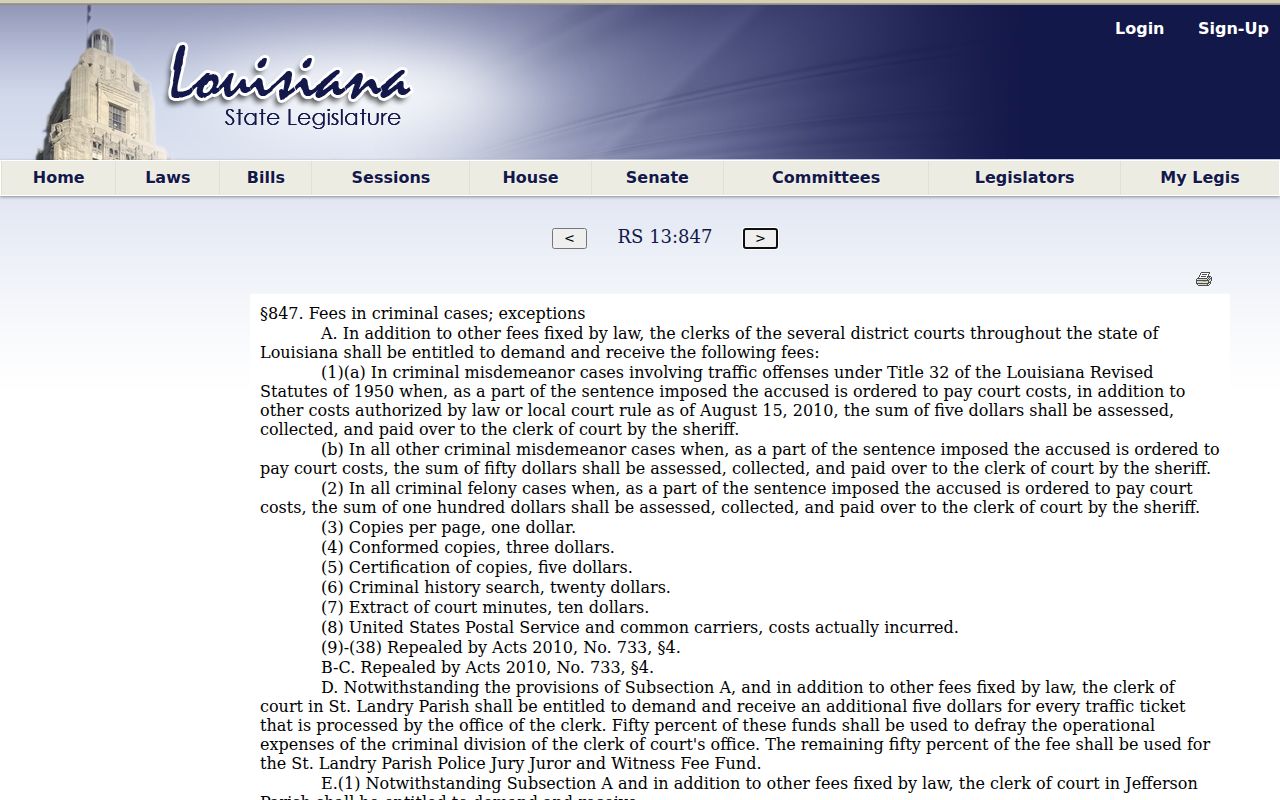
Certification authenticates a copy; it does not add facts missing from the court file or turn a single docket into a statewide rap sheet.
When LACCH Lacks the Final Outcome
Louisiana's fingerprint-based LACCH record can show an arrest cycle without its final court disposition when systems have not matched or reported the outcome. That gap does not prove the East Carroll case remains pending. For one's own record, obtain a certified disposition from the clerk and use the Louisiana State Police Bureau of Criminal Identification and Information challenge process under R.S. 15:588.
Correction and expungement are different. Correction supplies missing or wrong event data. Expungement is court-ordered relief based on statutory eligibility. A dismissed charge may support a request for proof of outcome but does not by itself show that every agency record has been sealed.
Access Rules for Case Records
Public East Carroll court records are requested from the clerk, while investigative reports belong with the agency that created them. Louisiana R.S. 44:1 broadly defines public records, but other laws protect juvenile, sealed, expunged, victim-sensitive, and identifying information. Online views may omit data or documents available through a lawful counter request.
When a case does not appear, ask whether the spelling, division, date range, archive status, or access restriction explains the result. Request any segregable public portion and the statute supporting a withholding. Never treat absence from eClerks LA as a certified finding that no East Carroll case exists.
Investigative exemptions under R.S. 44:3 may affect police or prosecutor material, but they do not turn the sheriff into the custodian of the court docket. Send each request to the office that maintains the item. The Sixth District Attorney controls charging decisions; the clerk records what is filed and what the court does. When a broad request is denied, narrow it to a known docket, date, and document, and preserve the written response for follow-up.